
 1 day ago
4
1 day ago
4

When the Olympique Lyonnais women’s team officially became OL Lyonnes on 19 May, they came with a new mantra: “New story, same legend”. The eight-time European champions, now owned by Michele Kang and part of Kynisca – a multi-club ownership group dedicated to women’s sports that also already includes the Washington Spirit – are a “new project” with the aim of “developing as a women’s club with our own model”. As Kang put it: “The women’s team cannot just be a little sister to the men’s section.”
The OL Lyonnes era kicked off on 7 September, coinciding with the Lyon’s 1,000th match in the French women’s top division, against Marseille. Kang was present, alongside Mikel Zubizarreta, Kynisca’s global sporting director, who was poached from Barcelona Femení last year. On the pitch, new recruits snatched from other European clubs this summer – Jule Brand, Lily Yohannes, Ashley Lawrence, Ingrid Engen, Korbin Shrader and Marie-Antoinette Katoto – discovered what it will be like to play at the Groupama Stadium, where the men’s team plays, for the entire season.
Although the stadium felt a little empty that Sunday afternoon – the 59,000-seater venue was barely 10% full – the flagship club of French women’s football used the match to reassert its ambitions. “We absolutely want to win the Champions League again quickly,” says sporting director, Vincent Ponsot. Behind the scenes, some go even further, claiming that OL Lyonnes have “the best team in the history of women’s football” as well as the “best coach”.
The club’s sports staff has grown from 15 to 24, the administrative staff from 10 to 16, and the team dedicated to communication, marketing and fan experience has doubled, with new hires brought in from abroad to ensure the club stays ahead of its European rivals. Beyond human resources, financial means are also guaranteed by Kang, who has promised the construction of a state-of-the-art training centre in Mézieux on the outskirts of Lyon, as well as a purpose-build stadium, providing an agreement can be reached with the city council.
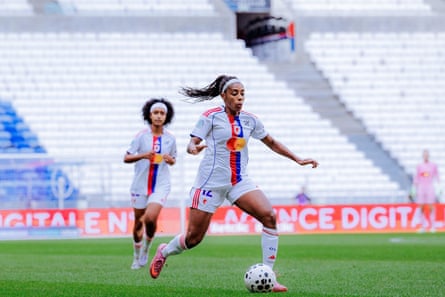
“We want to demonstrate that if we give the players the same means as the men, we can achieve the same thing,” says Ponsot, who points out that this is a “continuous improvement process”. The Groupama Stadium is a good example. Playing in this modern arena, opened in 2016, gives Lyon’s women visibility and spares supporters from switching between suburban grounds and the training centre.
Yet despite the club’s enormous trophy cabinet, OL Lyonnes struggle to fill the stands: after eight match days and five home fixtures, attendance averages 5,528 spectators. The best in France but far from enough to justify opening a vast new ground. “We’re facing a number of challenges in getting the men’s‑team fanbase interested,” Ponsot admits, citing Arsenal as a model for a club whose supporters attend both men’s and women’s matches.
On arrival in Lyon, Kang commissioned surveys to better understand who the women’s team’s supporters were and what they were seeking. “There was the notion of performance, excellence, winning,” explains Ponsot, formerly the men’s director of football, “but also the intrinsic values of the sport: respect, the ability to come to the stadium without hearing insults or experiencing violence, the closeness of players to the public … values that are less present in the men’s game and that are very important, even vital, for us.”
This is now the biggest challenge facing OL Lyonnes, a club trying every possible means to convince a different audience to come to the stadium, deploying a with giant foosball tables, face painting, and DJ sets in order to do so. The club have also struck an agreement with the newly created French Women’s Professional Football League (LFFP) to secure an ideal home‑and‑away rotation with the men’s team, sharing Groupama Stadium in alternating weeks.
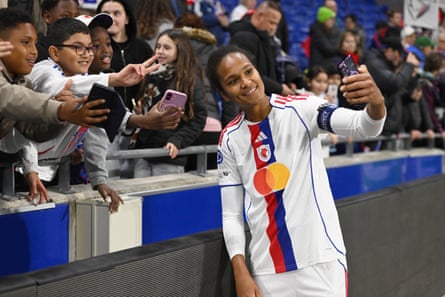
The other obstacle for this “dream big” project is the gap between OL Lyonnes’ rapid development plan and the broader reality of women’s football in France, which continues to struggle with economic limitations and a national sporting culture not particularly favourable to women’s sport. “Many things have improved since the creation of the women’s league in 2024: league structure, training centres,” Ponsot says, “but in terms of promotion and commercialisation, there is still a lot of progress to be made.”
after newsletter promotion
OL Lyonnes hope to inject new momentum into an under‑resourced Première Ligue. “The competitiveness of the French league has to improve,” says Ponsot after the team’s 6-1 victory over closest rival Paris Saint-Germain in match-day three. “If we don’t have stronger opposition at home, then when we play in the Champions League … the level keeps rising everywhere.”
Get in touch
If you have any questions or comments about any of our newsletters please email moving.goalposts@theguardian.com.
-
This is an extract from our free email about women’s football, Moving the Goalposts. To get the full edition, visit this page and follow the instructions. Moving the Goalposts is delivered to your inboxes every Tuesday and Thursday.





 English (US) ·