
 2 days ago
4
2 days ago
4

‘Tom said if we wanted to influence politics, we had to write great plays’
Natalia Kaliada and Nicolai Khalezin, co-founding artistic directors of Belarus Free Theatre
In 2005, we wrote to Tom Stoppard from inside the tightening grip of what has been described as the last dictatorship in Europe. We were building a theatre that wasn’t meant to exist in Belarus. Tom replied almost instantly: “You can count on my support. But what else can I do for you?” Our request was both audacious and simple: we asked him to come to Belarus.
He agreed, asking only for some time to finish the final edit of Rock’n’Roll. When he arrived, he didn’t give the classes we had asked for. Instead he listened, he asked questions. We took him to meet the whole underground resistance movement: artists, underground theatre-makers, the wives of friends who had been kidnapped and murdered, political prisoners, youth activists, journalists and human rights defenders. Sitting with us in the “London” bar in Minsk, he said something that captured everything we felt but had not yet found the words for: “A dictatorship is not a political category, it is a moral one.”
Tom became Belarus Free Theatre’s lifelong patron and our mentor. He told us, with a directness that always cut through the noise, that if we wanted to influence politics, we had to write great plays and stage great productions, because people only listen to those who know what they’re doing.
He proved that point at the Brussels Forum, one of the world’s most prominent political gatherings, where we had asked him to speak. For days afterwards, the corridors were ringing with praise for the playwright who understood the dangers of rising authoritarianism in Europe and beyond, more clearly than many politicians. He explained it simply, through the prism of his own childhood.
Tom was our guardian angel and dear friend. We will miss his love, his humanity, the moral clarity and steadiness he taught us to carry into the world. Thank you, dear Tom. We love you.
‘His face cracked up with that devilish smile’
Carrie Cracknell, directing Arcadia at the Old Vic in London next year
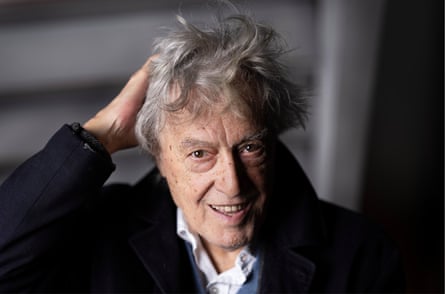
I can thank Tom for many things, not least for ending my very uninspiring early acting career. Cast as Annie in a student production of The Real Thing, I was simply no match for his dazzling dialogue, speed of thought or emotional depths. It was a moment of utter clarity about my own limits, and one that sent me headlong down a path to a career as a director. I told him this on one of our recent Zoom calls, and his face cracked up with that devilish smile that seemed to make the room change temperature.
It has been a great honour to have conversations with Tom over the past few months. His work ethic remained resolutely undimmed – engaging in each casting decision and wanting to discuss his beautiful, complex and multilayered play. At points he would pause for thought, cigarette in hand, and I would feel as though I was gazing through the screen at a living portrait, a precious moment in time. Aside from his profound intellect Tom seemed defined by a rare humility and genuine enthusiasm. As we begin rehearsals for Arcadia next week, his loss will be felt keenly by the whole company.
‘He suggested we stage the crowded bar scene on a table’
Nina Raine, director of Rock’n’Roll at Hampstead theatre, London, in 2023
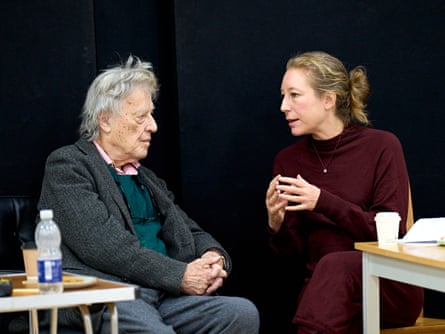
Tom was a weird mixture of contradictions. He was very charming. He was also brutal and blunt in the service of his plays. In Moscow, watching rehearsals of The Coast of Utopia, he once turned to me and whispered “I wish that actor would stop grinning like Father Christmas in a Coca-Cola commercial.”
Part of Tom was very literal. And part of him was delighted by the liberties, departure and flights of imagination taken by the director.
In Rock’n’Roll, Tom envisaged a totally realistic Cambridge house with a conservatory and garden (as seen in the first Trevor Nunn production in 2006). I saw an empty space, in the round, with a table. I could see Tom was uncertain about this bold move. The costume designer Anna Reid and I had a terrifying afternoon in Tom’s Notting Hill flat. Talking him through the model box, we couldn’t eat the sandwiches he’d bought us. At last, Tom seemed persuaded.
We then auditioned many tables (I texted him photographs). Was this too small? Did that look enough like a garden table? Could this also serve as a desk in Prague? I felt a huge pride, near the end of rehearsals, when Tom rang me to suggest we stage a crowded bar scene on the table. Finally, he was more radical than I was. Unfortunately, the table couldn’t take the weight of the actors.
In the hyper-naturalistic Nunn production, there were long blackouts with music. We, on the other hand, would go to a half-light, and non-verbal balletic “action” to music – as I explained to Tom often, feeling more pretentious each time. I absolutely dreaded him watching the process, so I cunningly arranged his afternoons off for our movement sessions. But I’ll never forget Tom deciding, unbidden, to stay on and watch. The actors were leaping about, jumping, skipping, primal-screaming – preparatory work. I was in agony. Tom watched, utterly fascinated, and then turned to the wonderful choreographer, Jane Gibson: “I’d like to do that.”



 English (US) ·